31 Dec 2013
Keeping up with my little tradition of sharing stuff I liked at the end of the year, here are some recommendations from 2013.
Perhaps the book I enjoyed the most was Saunders’ “Tenth of December”. Its short stories have the kind of warmth that comes from compassion in the face of (as opposed to in ignorance of) cruelty. Catton’s “The Luminaries”, set in the New Zealand gold rush, is great, too: thematic, thrilling, brainy yet mystical. Pullman’s retelling of the Brother Grimm’s tales is fresh and snappy, and Hamid’s “How To Get Filthy Rich in Rising Asia” is a good antidote to world-lit fluff.
I loved the poetry collection “Place”, by Jorie Graham. Its poems are strange miracles: systemic, yet focused on instants; comprehensive, yet intimate. Villalobos’ “Fiesta en la madriguera” (in Spanish) is a fun, surreal take on excess told from the perspective of the pampered scion of a drug lord. And while Daylight’s interview with Peter Naur, “Pluralism in Software Engineering”, is quite uneven, it has important insights into software development and academia that continue to be forgotten or put aside, to everyone’s detriment.
A couple of good movies: “No”, on the Pinochet referendum campaign, with its ambivalent, subtle take on social and political change, and “The Queen of Versailles”, a documentary on a ridiculous and ridiculously wealthy American family going through hard times. I’d recommend “Gravity”, but I doubt it needs recommendation. I also enjoyed the genre mix of the British TV version of “Life on Mars”, and the silliness of “Archer”. As for music, I liked the bassy intensity of Savages’ “Silence Yourself”, and Chris Thile’s album of Bach’s sonatas and partitas played on the mandolin.
I was able to run again, injury-free, throughout the year, largely thanks to daily (and initially painful) stretches on a foam roller. It’s such an unassuming, cheap, yet useful accessory. I must have tasted every olive oil and balsamic vinegar at Olive the Senses half a dozen times (and if you are in Victoria you should, too). Finally, while I’ve been intimidated by electronic tinkering almost all my life, the Arduino Experimenter Kit was a very straightforward way to get me started on designing circuits and devices (and check out node-ardx, a great resource to go through the experimenter kit exercises using Node).
That’s it. Happy New Year!
(Previously: 2012, 2011, 2010, 2009)
14 Aug 2013
A few years ago I wrote a pretty critical post on the then-new SEMAT initiative, which wanted to “refound software engineering” with a “solid theory, proven principles, and best practices”. Recently, Ivar Jacobson and others published a book (“The Essence of Software Engineering”) to introduce practitioners to the SEMAT “kernel”. The book is worse than I feared. Greg Wilson and I review it at the Never Work in Theory blog.
06 Aug 2013
These have been times of important anniversaries for me. In the past few days I’ve celebrated ten years in Canada, one year out of academia, and three months with Limbic Consulting.
In 2003, when Val and I moved to Toronto and I started my Master in Computer Science degree, I thought that my stay in both Canada and academia would be temporary. A couple of years, at most. But I discovered I liked both too much—enough to think of staying in them permanently. Years later, as it turned out, Canada is happily still our home, but I became disenchanted with the academic house, or rather with my corner of it, and left.
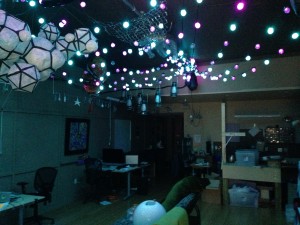 Professionally, this last year has been excellent—I feel like I had been in danger of being left behind by the software industry, and that I’ve caught up again. After a stint at Terapeak (a company where I learned much, but whose goals diverged with mine) I joined Limbic. I’m very glad I did. Limbic is a small firm (which I think is great) filled with smart, fun, kind, multidisciplinary people. The office feels equal parts grad lab, electronics workbench, Agile shop, and surreal cave.
We’ve got an art gallery attached to our workplace, a tickle trunk with wigs and costumes to use in standup meetings (and whenever the conversation gets heated), a dictionary of modern thought and back issues of Make as our washroom reading material, great coffee, and healthy snacks. Most importantly, the projects we are working on are both technically challenging and fun, and we have the autonomy to work on them the way we think is best. It’s a pretty unique place, and an exciting time for me.
27 Jan 2013
It’s been a while since I last wrote about vegetable gardening, but it occupies my mind quite a bit and I should share some of what’s going on. At home, we’ve had two growing seasons so far, the second being more demanding (and more rewarding!) than the first: we almost tripled our garden area.
We grew spinach, lettuce, kale, swiss chard, peas, beans, tomatoes, tomatillos, hot peppers, garlic and garlic scapes, strawberries, cilantro, and carrots. Without any actual effort we also got rhubarb and blackberries, whereas despite our efforts we had no zucchini, cucumbers, leeks, nor onions. The hot peppers and the carrots could have done much better, and I think they will this time around. Bringing the garlic heads out of the soil after spending about three quarters of a year there felt glorious, even though some heads came out with only three or four cloves.
Although I was not keeping track in detail, I think that the amount we saved on food, for veggies of this quality, surpassed the amount of money we put into the garden last year. Of course, I don’t do gardening to save money, but it’s a nice comparison: I’m sure this was not the case the year before last. This year we’re making some “investments”: a cloche frame (a kind of mini greenhouse) for the tomatoes and peppers, and an irrigation system for more consistent watering—it was difficult to find time every day to water an area this big during the Summer.
I like how gardening has become an important part of my life. I wouldn’t have expected that a few years ago: I was extremely careless and ignorant about plants. I’m still pretty much a novice, but I find the experience alternatively absorbing and dissipating. It gives life (including human life—gardening while being a new parent made the link evident to me) a more natural perspective than what I’d grown to expect in an urban environment. So here’s to many more growing seasons! And if you’re thinking about having a garden, this may be the right time to get started with your planning.
27 Dec 2012
The year wraps up, and I’d like to share a batch of recommendations for stuff I enjoyed in 2012.
First, books. I simply loved Semple’s “Where’d You Go, Bernadette?”. I was expecting it to be funny, but I was surprised to discover it was also clever and humane. Though I usually dislike books about drunkards or addicts, deWitt’s “Ablutions” was fresh and very, very good—after this and “The Sisters Brothers” I’m platonically in love with him. Ford’s “Canada”, a novel about a kind young soul growing among adults that can’t help but bring destruction on themselves, is written with wisdom and skill. Spufford’s “Red Plenty”, an extremely multithreaded novel about communist Russia’s central planning, was not great, but I still appreciated its ambition and originality.
As for non-fiction, I found Lucretius’ “On the Nature of Things” to be awe-inspiring: at times it would seem as if all of modern science had only worked on relatively minor corrections of his understanding of the world, while ignoring his impassioned claim that the whole point of these endeavours is to bring inner peace to humankind. Berger and Luckmann’s “The Social Construction of Reality” was wonderfully compelling, lucid, and witty. It is the book I wish I’d read at the start of my doctoral work. For something lighter, Glouberman and Heti’s “The Chairs Are Where the People Go” is an endearing and frank collection of micro-essays.
I had a good year with books in Spanish, too. The slightly unhinged lovers of Pauls’ “El Pasado” spiral down to disaster with exquisite prose. Borges’ collection of lectures, “Siete Noches”, is a touching display of his brilliance and kindness, and “Los Conjurados”, his collection of late poems, is concerned with history, transcendence, insignificance, and lives lived nobly and simply. Krauze’s trilogy of Mexican history (“Siglo de Caudillos”, “Biografía del Poder”, and “La Presidencia Imperial”) is captivating and often lyrical, although his main thesis—that Mexican history to a large extent can be reduced to and explained by the biographies of its leaders—loses strength as Mexico approaches the present time.
I’m still playing catch-up with recent movies, and I doubt I could recommend anything you wouldn’t know of already (but watch “Moonrise Kindgom” if you haven’t). One exception might be “Small Town Murder Songs”, a low budget Canadian independent film that is subtle but powerful. It features music by Bruce Peninsula–another recommendation on its own right. Going much further into the past, I found Bergman’s “Wild Strawberries” to be almost perfect.
Online, I enjoyed Bret Victor’s essays. He’s clearly a genius—one I often don’t agree with, but this makes his writing all the more engaging. The New Yorker’s Fiction Podcast features authors reading other author’s works, as well as conversations with Deborah Treisman, and it is consistently superb.
Among my guilty pleasures, I loved being distracted by three sites whenever they had an update: What If, for silly questions explored seriously to everyone’s satisfaction; Horsey Surprise, for a satire of online comment trolls, and Textastrophe, for SMS pranks. I didn’t have much time for gaming, but most of what I had went to XCOM: Enemy Unknown, and, in the past few weeks, to Tropico 3, a sort of SimCity where you’re not a city mayor, but a tropical island dictator during the Cold War.
At work, we’re using Dropwizard to structure our web services, and I liked the way it puts all the relevant pieces together. For a personal project, I used and liked node.js and socket.io, and it was refreshingly easy to get my application running with them. I also toyed with D3.js, and I’m looking forward to a time when I can put it to good use—Mike Bostock’s site has fantastic examples of his library at work.
I believe that’s all. If you haven’t read them and are curious, I’ve written similar posts for 2011, 2010, and 2009. I hope you’ll find some of these recommendations useful, and I wish you a Happy New Year!