08 Feb 2011
 Val and I went to see “Circo” at the Victoria Film Festival last Saturday. It’s a documentary directed by Aaron Schock about a struggling circus touring rural Mexico, and about the family whose members own it, publicize it, set it up, perform in it, take it down after a day or two, and move on to the next town (tigers, camels, and llamas in tow), barely scraping enough to get by, torn between business and family obligations, dreaming of the days when their acts will be more solid and their crew larger so that they’ll be able to compete in the big cities, but seeing those dreams move farther and farther away with each stop on the road.
It’s a very good documentary, and one of those rare movies that portray Mexico as it really is. It is not afraid of exploring my country’s complexities in full, but it does so gently, sweetly, and lovingly. I hope it will get a wider distribution. Catch it if you can. Here’s an interview with Schock, if you’re interested in learning more.
15 Jan 2011
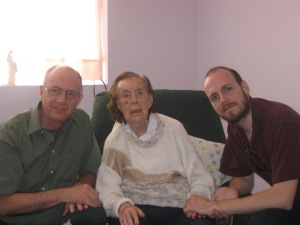
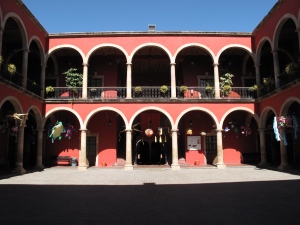 Val and I came back from León a week ago, after a much needed month-long stay. It was a bittersweet visit: I was delighted to see so many friends and family doing well, but while we were there, on January 2nd, my grandmother died of pneumonia after a long decay. I expected it to happen any day for the past few years (and, all things considered, I am glad she’s finally at peace), but I did not expect to be there to say goodbye.
 I find now that going back to my hometown makes me feel older—or rather, it lets me realize my age, the status of my generation. I have plenty of younger nephews and cousins that I can barely recognize, and to whom I’m only vaguely familiar too. “Do you know who I am?” often draws out a negative, as it did when I was a boy and some traveling relative (an Older Man, to my eyes) came to León on a visit. Many of my friends have left the city or are otherwise engaged in grown-up activities and worries: mortgages, kids, schools, and the like. And the city, of course, has grown and changed: I find it slightly unsettling and unfamiliar how the old paths I took no longer take me where I want to go, and how the places I want to go to are not necessarily there anymore. In Toronto, and now in Victoria, I’m somewhat removed from all this; having it all hit me at once is a bit of a shock.
 And yet it’s all good: seeing all these people and places, however different from those that I left behind on our previous visit, still brings out many of the same chords and emotions, the same aromas and flavours that are a part of me and that I didn’t know I’d miss so much, because I hadn’t learned to tell them apart from those of the rest of the world.
29 Dec 2010
We’re wrapping up another year, so I thought of sharing pointers to some of the things that got me excited throughout 2010 while I was not burying my head in my thesis or packing for our move to Victoria.
In terms of books, last year around this time I was very excited by Javier Marías’ trilogy, “Tu Rostro Mañana.” I still haven’t read it, unfortunately, but I did read the older “Corazón tan Blanco,” and I loved its flowing prose and its subtle plot. I was quite surprised with Roberto Bolaño’s “El Tercer Reich“—not by its quality (Bolaño is always fantastic), but by the discovery that he must have been, for a while at least, a boardgame geek: the novel narrates, with plenty of interest, a match of a game that seems to be “The Rise and Decline of the Third Reich” between a German nerd and a tortured South American. I know only two other novels that take a serious look at boardgaming (Kawabata’s “The Master of Go” and Nabokov’s “The Defense“); I love the former, and I have not read the latter.
I also plunged into Proust’s “In Search of Lost Time,” which has taken me a little more than I expected (I’ve only just finished Volume III), but I’m thoroughly enjoying every page. It’s not just the hypnotic prose (and I wish I could read it in the original French), but the blindingly bright cognitive, psychological, and sociological insights—a humbling masterpiece.
Probably the best non-fiction book I read this year was Paul Edwards’ history of the development of climate modeling, “A Vast Machine.” It’s engaging, timely, and fairly accessible, while exploring the difficult epistemological questions of climate simulation. On a different topic, Richard Evans’ historical trilogy of the Third Reich is engrossing and informative, and probably the best I could ask for to understand that brutal period of history.
To get a fascinating individual perspective of that time, you should read or subscribe to the “Orwell Diaries” blog, which posts entries from George Orwell’s journal seventy years to the day (so the most recent entry today is from December 29th, 1940, in the midst of Germany’s campaign of aerial bombings in the UK—thanks to Greg Wilson for the pointer). For more recent events, there are several blogs I came to love this year: George Monbiot‘s provides great commentary on ecological and social affairs (and he engaged in a wrenching debate with my PhD advisor, Steve Easterbrook, on the topic of the East Anglia emails). The New York Times’ “The Stone” blog demonstrates that philosophy is practical and relevant. Boston.com’s “The Big Picture” is a jaw-dropping photo blog (thanks to Michael Tobis for the tip). The New Yorker Fiction podcast features cool short story readings and discussions. And after the G20 meeting in Toronto, I discovered the Waging Nonviolence blog, which among many inspiring news and reflections on non-violence pointed to this essay on the futility of the Black Bloc that I wish was more widely read.
I’ve mentioned some of the great things we’ve discovered in Victoria in the few months we’ve been there (the delicious food from the Puerto Vallarta Amigos’ taco truck, Lifecycles’ fruit picking project), but there’s others I have not talked about: the Good Food Box (which is as great as Toronto’s, except for the fact that deliveries are monthly, not biweekly); the Springridge Commons permaculture garden and the Haultain Boulevard’s street garden, where anybody can come and pick any fruit, vegetable, or herb they like (just leave enough for the rest!); and Transition Victoria, the local Transition initiative, of which I should talk more in a later post.
It wasn’t a great year for new movies for me: we rented plenty of wonderful classics, but I was mostly disappointed at the movie theatre. Two notable exceptions: the mexploitation extravaganza of “Machete” and the Toronto-loving geeky fantasy of “Scott Pilgrim vs. the World.” It wasn’t a great year for boardgames either (though I’m holding out for “The Resistance“), except for the hours and hours I spent playing Go, a game of intimidating depth and beauty that I appreciate more with every match I play (I’m “yorchopolis” at the Dragon Go Server; feel free to invite me to a game!).
Some software tools and I’m done; these may be old news for you, depending on where you’re coming from: I discovered Mendeley for managing my library of academic papers and notes (after painfully parting without my annotated paper copies of hundreds of papers in Toronto), I started taking advantage of Instapaper to reduce the clutter of my browser tabs, and for task management I switched from Toodledo (which was alright) to Omnifocus (expensive, but it fits like a glove!).
That’s it, I think. I hope you enjoy these as much as I have, and I wish you a happy New Year!
16 Dec 2010
Vale y yo andamos de visita en León para cerrar el año. Encuentro la ciudad menos cambiada que la última vez que venimos; quizá porque aquella ocasión vimos abierto por primera vez el nuevo distribuidor vial. Entre las novedades buenas y malas que me han llamado la atención en esta visita hasta ahora:
- Cada vez hay más contaminación. En la mañana se distingue una nube de smog sobre toda la ciudad.
- El Forum Cultural tiene un nuevo teatro, supuestamente buenísimo, que tendremos que visitar.
- En la entrada a la ciudad desde el aeropuerto hay un nuevo monstruo: un centro de “outlets” de zapatos. No me explico cómo piensan estas zapaterías mantener también todas sus otras sucursales en la ciudad.
- Más ciclovías.
- Más tráfico.
- La comida china y thai como que se empieza a poner de moda.
- Un circo de los Backyardigans.
21 Nov 2010
Last week I attended my convocation at the University of Toronto. It was a long and fairly boring ceremony, but I think I needed it: finishing a doctorate is one of the most anticlimactic events there are, considering the effort it takes to do it! I think the problem is that there are too many “almost there” points, or at least there were in my case:
- You finish a decent draft of your thesis, but you realize there’s still lots of rough edges to polish. Okay!
- You hand in your “final draft” to your committee. You’re proud of it. Yay! But you can’t celebrate yet: you need to prepare for the exam.
- You pass the exam! But now you have a list of changes to make to your thesis, and you better do them quickly if you’re pressed for time (as I was) and if the scheduling window of the external or Senate defense is narrow (as mine was).
- You hand in your thesis with the changes your committee requested. It took you a while, mainly because the thought of editing the Thing is dreadful. Never mind, though, it’s done. Yay again! But of course you still can’t celebrate: you need to prepare for the external defense (and for the snake fight).
- You pass the defense! Woo hoo! You’re unofficially a Doctor now! Everyone calls you that. Except you still have a significant list of corrections for That Blasted Document you call your thesis.
- In the solitude of your desk, you drag yourself to make those final changes. At some point in the middle of the night, you send it to your advisor; then you crawl to bed.
- Hours or days later you get an email: your advisor accepted the changes. You upload the final version to the University’s database. A day later you get back an email saying that your upload failed because you didn’t name your PDF file quite the right way. You fix the filename and resubmit. You’re done.
And that’s it! “Not with a bang, but a whimper.” So after all, after so many false endings, I felt as if I wasn’t quite there yet. I would go to work every day as a “postdoctorate fellow,” which implies I’m done with school, yet except for a few moments I would slip back to that student frame of mind, with the sole difference that I wouldn’t have a thesis to write anymore.
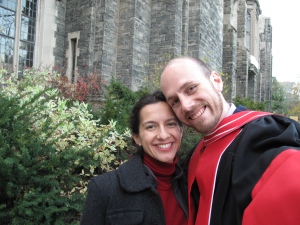 So we flew to Toronto, where I met again with plenty of friends (but my time was tight, and I didn’t see or chat with many that I wanted to!), wore fancy clothes, attended convocation, briefly shook hands with the bigwigs present at the ceremony, and came back to Victoria with a framed piece of paper that says I’m done. It’s too early to say if it truly worked in giving me closure, but I’m glad I did it.
 Val and I went to see “Circo” at the Victoria Film Festival last Saturday. It’s a documentary directed by Aaron Schock about a struggling circus touring rural Mexico, and about the family whose members own it, publicize it, set it up, perform in it, take it down after a day or two, and move on to the next town (tigers, camels, and llamas in tow), barely scraping enough to get by, torn between business and family obligations, dreaming of the days when their acts will be more solid and their crew larger so that they’ll be able to compete in the big cities, but seeing those dreams move farther and farther away with each stop on the road.

